
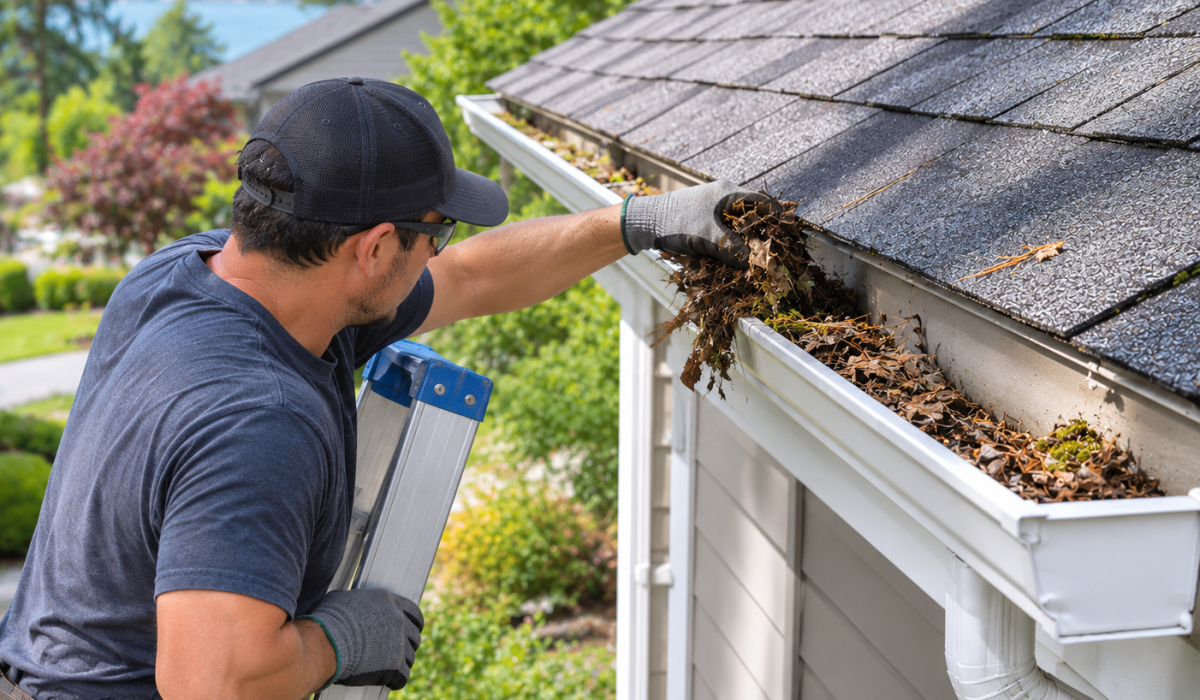
Gutters get treated as a separate, lower priority maintenance item from the roof itself, something to think about occasionally rather than something directly tied to how long a roof actually lasts. In practice, the two are closely connected, and neglected gutters contribute to roof problems in ways that are not always obvious until the damage has already started.
How clogged gutters actually affect the roof above them
When gutters fill with leaves, needles, and debris, common under Victoria’s mature tree canopy, water backs up rather than draining away as designed. That backed-up water sits against the lowest courses of shingles at the eaves far longer than it should, which accelerates granule loss and shingle aging exactly at the roof’s most vulnerable edge. In colder snaps, this same standing water is part of what contributes to ice damming, covered in more detail elsewhere, since water that cannot drain properly is more prone to freezing and backing up under shingles.
Fascia and soffit damage from overflow
Water overflowing from clogged gutters runs down the fascia board, the trim running along the roof edge behind the gutter, rather than through the downspout system as intended. Sustained exposure to this overflow causes the fascia to rot over time, and once fascia begins failing, it can compromise the gutter’s own mounting attachment, creating a cycle where a maintenance issue that started as a clogged gutter progresses into a structural repair involving both the fascia and the gutter system itself.
Soffit vents, the intake ventilation covered in our attic ventilation article, can also become blocked by overflow debris or water damage in this same area, which then affects attic airflow on top of the direct fascia damage.
Foundation and drainage consequences
Gutters exist to direct roof runoff away from the house foundation, and when they are clogged or damaged, water dumps directly along the foundation line instead of being carried safely away through downspouts. Over time, this contributes to foundation moisture issues, potential basement or crawlspace dampness, and soil erosion right at the base of the house, problems that started as a roof and gutter maintenance issue but end up affecting an entirely different part of the home.
What proper gutter maintenance actually involves
- Clearing debris at least twice a year, more often on heavily treed properties, typically before and after the fall leaf drop
- Checking that downspouts are clear and directing water at least several feet away from the foundation
- Inspecting gutter attachment points and fascia condition for early signs of sagging or rot
- Confirming gutters are properly sloped toward downspouts rather than pooling water partway along their length
- Considering gutter guards on properties with particularly heavy debris load, while understanding guards reduce but do not eliminate the need for periodic checks
Gutter guards: what they actually do and do not solve
Gutter guards reduce the volume of debris entering the gutter channel, which meaningfully cuts down on cleaning frequency, particularly valuable on properties with heavy conifer needle drop where standard gutters clog quickly. They do not eliminate maintenance entirely, fine debris and needles can still work through many guard designs over time, and guards themselves need occasional checking to confirm they have not become clogged on their surface even while protecting the channel underneath. They are a genuine improvement for high-debris properties, not a permanent fix requiring zero attention.
Signs your gutters are already affecting your roof
Beyond obvious overflow during rain, a few less obvious signs suggest gutters are already contributing to a problem rather than just needing routine cleaning. Staining or dark streaking on the fascia board visible from the ground often indicates repeated overflow has been occurring for some time. Gutters that visibly sag or pull away from the roofline in sections suggest either debris weight or fascia deterioration already underway. Plant growth actually sprouting from accumulated debris in a gutter is a clear sign cleaning has been overdue for a while, since it takes sustained organic buildup for anything to actually take root.
Coordinating gutter and roof maintenance on the same schedule
Since gutters and roof condition are as connected as this article describes, it makes practical sense to have both assessed together rather than on entirely separate schedules. A routine roof inspection, discussed in our other maintenance articles, is a natural opportunity to check gutters at the same time, catching issues in either system before they have a chance to affect the other.
Downspout placement and extension considerations
Even a perfectly clear gutter system underperforms if downspouts discharge too close to the foundation. Downspout extensions carrying water several feet further away from the house, or tying into a proper drainage system where grading allows, meaningfully reduces the foundation moisture risk described above. This is a relatively low-cost improvement worth checking on any property where downspouts currently just dump water at the foundation line.
How gutter condition factors into a reroof decision
During a full reroof, gutters are typically detached and reattached, which is a natural point to assess whether they are due for replacement rather than reinstalling aging or already-damaged gutters onto a brand new roof. Raising gutter condition with your roofing contractor during the reroof planning conversation, rather than treating it as an entirely separate project, often makes sense both for cost efficiency and for avoiding a mismatch between a new roof’s expected lifespan and an old gutter system nearing the end of its own.
Frequently asked questions
How often should gutters actually be cleaned in Victoria?
For most properties with typical tree cover, twice a year, before and after the fall leaf drop, is a reasonable baseline. Properties with heavy conifer coverage or numerous large deciduous trees may need checking more frequently.
Can clogged gutters really cause roof leaks?
Indirectly, yes. Standing water at the eaves accelerates shingle wear at that specific location and contributes to ice damming risk during cold snaps, both of which can lead to leaks that trace back to gutter maintenance rather than a shingle defect elsewhere on the roof.
Are gutter guards worth the investment?
For properties with heavy debris load from mature trees, generally yes, since they meaningfully reduce cleaning frequency even though some periodic maintenance is still needed. For properties with minimal tree cover, the investment matters less.
Should gutters be replaced during a reroof even if they seem functional?
Not necessarily automatically, but it is worth having them assessed during the reroof planning process, since coordinating replacement at the same time as a new roof, if they are genuinely due, is more efficient than treating it as a separate future project.
What are the earliest warning signs gutters are affecting my roof?
Staining on the fascia board visible from the ground, gutters sagging or pulling away from the roofline, and plant growth in accumulated debris are all signs that cleaning or repair has been overdue and may already be affecting nearby roof components.
Can I clean my own gutters safely?
Some homeowners do, with proper ladder safety precautions, though ongoing fall risk and the difficulty of thoroughly inspecting fascia and roof edge condition from a ladder make a professional service a reasonable choice, particularly for two-story homes or steeper roof lines.
If your gutters have not been checked in a while, or you are planning a reroof and want gutter condition assessed at the same time, Shoreline Roofing can take a look and give you a clear picture.