
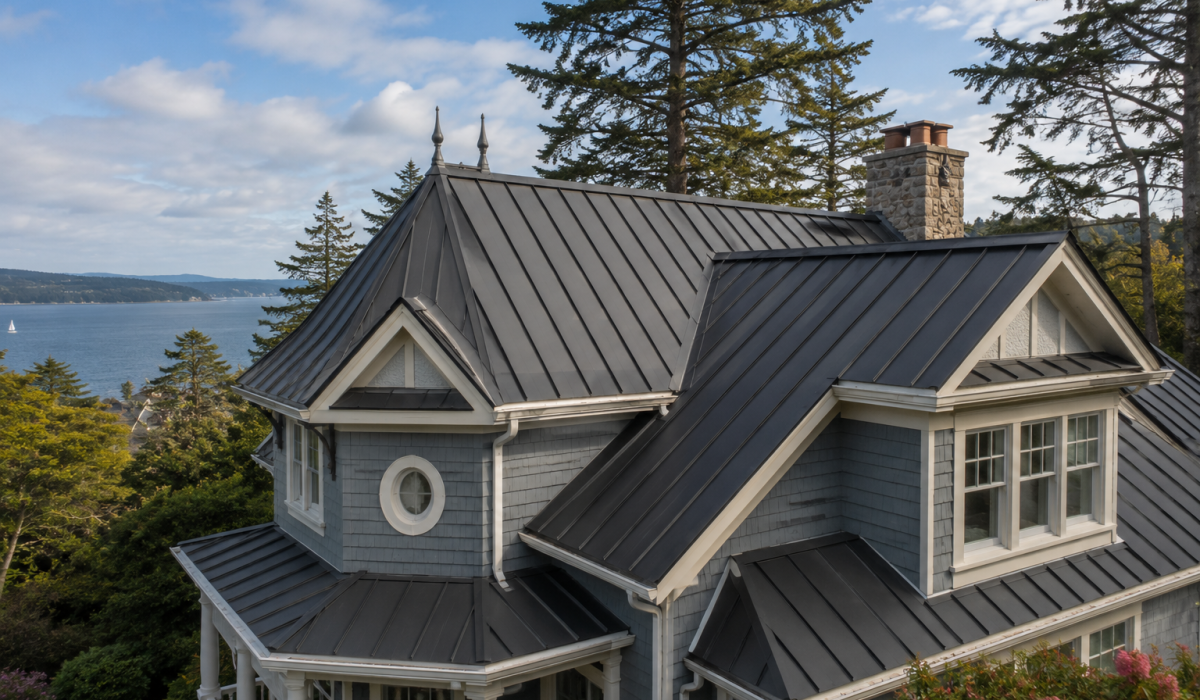
Metal roofing has a reputation problem it doesn’t really deserve. Ask around and you’ll hear it’s loud in the rain, it’s only for barns and cabins, or it costs a fortune. None of that holds up particularly well anymore, and in a climate as wet as ours, metal is quietly one of the best-performing options on the market. It’s just not the cheapest one, and that upfront number is usually what ends the conversation before people look at the rest of the picture.
Here’s an honest look at what metal roofing actually costs in Victoria, how it holds up against our specific weather, and who it genuinely makes sense for.
What Metal Roofing Actually Is
“Metal roof” covers a range of products, and the differences matter. Standing seam panels—long, continuous vertical panels with raised seams that interlock—are the most common choice for homes and the one most people picture. Metal shingles or shakes are formed to mimic the look of traditional roofing while keeping metal’s performance underneath. Corrugated and exposed-fastener panels are more common on outbuildings and cost less, though they carry more risk of leaks at the fastener points over time.
Most residential metal roofs in this region are steel or aluminum, coated for corrosion resistance and finished in a baked-on paint system that holds colour for decades. Steel is more common and slightly cheaper. Aluminum resists corrosion a bit better, which matters near the water, and is lighter, though it costs more.
Why It Performs So Well in Victoria’s Climate
Metal roofing was practically made for a coastal climate like ours, for a few specific reasons.
It sheds water aggressively. The panel seams and steep effective slope of most metal profiles move water off fast, which matters through months of sustained rain where a slower-draining material spends more time wet.
It resists moss far better than shingles. Moss needs a surface to grip and moisture to hold against. A smooth metal panel gives it almost nothing to work with, especially compared to the textured, porous surface of asphalt shingles that Victoria’s shaded roofs struggle with constantly.
It doesn’t absorb water into the material itself. Asphalt shingles are porous and take on moisture over time, which is part of what shortens their life in a wet climate. Metal simply doesn’t absorb, so the persistent dampness that ages shingles faster here barely touches it.
It handles our mild winters without complaint. Victoria doesn’t get the deep freeze-thaw cycling of the interior, so metal’s main weakness in harsher climates—expansion and contraction stress—is a smaller factor here than almost anywhere else in the province.
Put together, metal roofs in this region routinely outlast every other common material by a wide margin.
How Long a Metal Roof Actually Lasts Here
A properly installed metal roof in Victoria typically lasts 40 to 50 years, and many well-maintained installations go longer than that. Compare that to 15 to 22 years for asphalt shingles in our realistic local conditions, or 20 to 30 for cedar shake, and the gap is enormous. A metal roof installed today could plausibly be the last roof that home ever needs, which changes the entire way you should think about the upfront cost.
What Metal Roofing Costs in Victoria in 2026
Installed metal roofing in Victoria generally runs from $18,000 to $35,000 for a typical single-family home, depending on panel type, roof complexity, and size. Standing seam, the premium option, sits toward the higher end. Metal shingles and simpler profiles can land lower.
That’s roughly double an asphalt shingle reroof on the same house. It’s a real number, and it’s the main reason metal isn’t the default choice for most homeowners. But the comparison only tells the whole story when you factor in that an asphalt roof will very likely need replacing again, sometimes twice, within the lifespan of a single metal roof. Priced out per year of service, metal is often close to a wash against shingles, and can come out ahead once you count the labour and disruption of repeated tear-offs.
A few things move metal pricing specifically:
Panel type. Standing seam costs more than exposed-fastener corrugated panels, largely due to the more involved installation and concealed fastening system.
Roof complexity. Metal rewards simple rooflines. A roof with many valleys, dormers, and penetrations takes considerably more custom flashing work than a straightforward gable roof.
Underlayment and venting upgrades. A quality metal install includes a proper underlayment system and attention to ventilation, since trapping moisture under any roofing material, metal included, causes problems.
Existing roof removal. Metal can sometimes go over an existing asphalt roof in the right conditions, which saves on tear-off, though a full tear-off is usually the better long-term choice and lets the installer address the deck properly.
What Metal Roofing Doesn’t Do Well
It’s worth being honest about the downsides too.
Noise is real, but manageable. A bare metal roof directly over living space can be noisier in heavy rain than shingles. In practice, proper solid sheathing and insulation underneath largely solve this, and most homeowners report it’s far quieter than the reputation suggests once installed correctly.
Dents from impact. Metal can dent from significant hail or falling branches, more than shingles would show. Victoria doesn’t see damaging hail often, but overhanging trees are worth trimming regardless of roof material.
Higher skilled-labour requirement. Metal roofing rewards an experienced installer more than almost any other material. Seams, flashing, and expansion allowances all have to be done correctly, and a crew that mostly does shingle work can get this wrong in ways that aren’t obvious until years later.
A repair looks different. Fixing a section of metal roofing isn’t quite as simple as swapping a shingle, and colour matching an older panel can be tricky. In practice, this rarely comes up given how infrequently a well-installed metal roof needs repair at all.
Who Metal Roofing Actually Makes Sense For
It’s the strongest fit for homeowners planning to stay long-term, since the value shows up over decades rather than in the first few years. It’s also a natural fit for anyone tired of the cycle of reroofing every couple of decades, or for homes with heavy tree cover and a chronic moss problem that keeps shortening shingle life no matter what maintenance is done. And it suits homeowners who value a clean, modern or contemporary look, since metal panel roofing has become a genuinely popular architectural choice in newer Victoria builds, not just a practical one.
It makes less sense for a short-term hold, a tight renovation budget with other priorities, or a heritage-designated home where roofing style is restricted by guidelines.
Frequently Asked Questions
Does metal roofing really last twice as long as asphalt in Victoria?
Realistically, yes—and often more. A well-installed metal roof commonly reaches 40 to 50 years here, against 15 to 22 years for asphalt shingles in our specific damp, shaded conditions.
Is metal roofing louder in the rain than shingles?
With proper solid decking and insulation, the difference is much smaller than people expect. A bare metal roof with minimal underlayment is louder. A properly built system is not something most homeowners notice day to day.
Can metal roofing be installed over my existing shingles?
Sometimes, depending on the condition of the existing roof and local code requirements, but a full tear-off is usually recommended so the deck can be inspected and properly prepared underneath.
Does metal roofing help with moss, which is a big issue on my street?
Significantly. Moss struggles to establish on a smooth metal surface the way it does on textured asphalt shingles, which is one of the more underrated benefits for shaded Victoria properties.
Is metal roofing a good fit for a heritage character home?
It depends on the specific property and any heritage guidelines that apply. Some heritage-designated homes have restrictions on visible roofing materials, so it’s worth checking with the municipality before committing to a style change.
Find Out What Metal Roofing Would Actually Cost for Your Home
Metal roofing isn’t the right call for every house, but for the right home it’s the closest thing to a roof you install once and stop thinking about. The only way to know what it would genuinely cost for your specific roof, and whether it makes sense for your plans, is a proper on-site look.
Shoreline Roofing has installed and repaired metal roofing across Greater Victoria for more than 30 years, and we’ll give you a straight comparison against asphalt and other materials for your specific home, with no pressure either way. Reach out today for a free estimate and find out what metal roofing would actually mean for your property.