
What Torch-On Roofing Is and How It Works
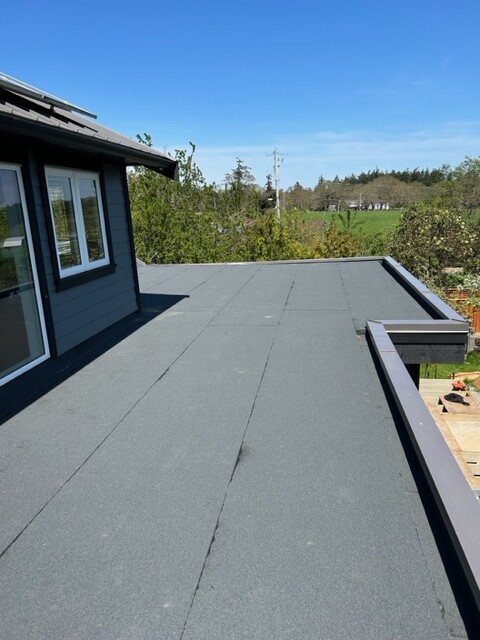
Torch-on roofing — also called modified bitumen roofing — is a multi-layer membrane system applied using an open-flame propane torch. The torch melts the underside of the membrane, bonding it directly to the substrate or the layer beneath it. This heat-welded bond is what makes the system so reliable in wet climates.
A complete torch-on installation typically consists of:
• A base sheet, mechanically fastened or adhered to the roof deck
• A cap sheet with a granulated or smooth surface finish
• Flashing at all penetrations, walls, drains, and edges
The modified bitumen compound — usually APP (atactic polypropylene) or SBS (styrene-butadiene-styrene) — gives the membrane flexibility and UV resistance that standard bitumen lacks. SBS in particular remains pliable in cold temperatures, making it well-suited for Victoria’s cooler shoulder seasons.
What sets torch-on apart is the installation method itself. A trained crew with calibrated torches creates seamless, monolithic surfaces with no exposed adhesives, seams reliant on glue, or mechanical fasteners in the field. Done right, water simply has nowhere to get in.
Why Flat Roofs Are Common in Victoria and Greater Victoria
Drive through downtown Victoria, James Bay, Oak Bay, or Langford and flat and low-slope roofs are everywhere. There are a few reasons for this:
• Heritage and mixed-use commercial buildings built in the early 20th century were designed with flat roof profiles that match their architectural style
• Modern commercial and industrial construction favours flat roofs for HVAC equipment, mechanical systems, and usable rooftop space
• Strata and multi-family residential buildings in Saanich, Esquimalt, View Royal, and Colwood increasingly feature low-slope rooflines that require flat roof systems
• Additions and extensions to existing homes in Greater Victoria are often built with flat roofs to avoid complex tie-ins with sloped structures
Flat roofs do not drain by gravity the way pitched roofs do. They rely on internal drains, scuppers, and precise slope-to-drain installation to move water off the surface. In a place that receives roughly 600 mm of precipitation per year — much of it as persistent drizzle from October through April — that drainage design, and the membrane above it, must be flawless.
Why Coastal Moisture and Standing Water Make Torch-On the Right System
Victoria’s climate is technically classified as warm-summer Mediterranean, but any local will tell you the winters are grey, damp, and relentless. The roofing implications are significant:
• Standing water is a constant risk on improperly graded flat roofs. Water that ponded for 48+ hours degrades most roofing membranes over time through hydrostatic pressure
• Salt air from the Strait of Juan de Fuca accelerates oxidation and brittleness in roofing materials not designed for coastal exposure
• Temperature cycling between summer highs around 24°C and winter lows near freezing creates repeated expansion and contraction stress on any membrane system
• Moss and algae growth in shaded areas can lift and degrade poorly adhered seams
Torch-on’s heat-welded seams eliminate the adhesive failure points that plague peel-and-stick membranes in these conditions. The granulated cap sheet sheds water efficiently, resists UV degradation in summer months, and stands up to the freeze-thaw cycling that Victoria’s climate produces.
SBS-modified torch-on membranes in particular are engineered for high moisture environments. The rubber polymer content keeps the membrane flexible at low temperatures, preventing the cracking that plagues older built-up roofing (BUR) systems in the same conditions.
Shoreline has been installing and repairing flat roofs in Victoria for over 30 years. That experience means we’ve seen firsthand how different systems perform in this specific climate — and why torch-on consistently outperforms the alternatives.
Torch-On vs Other Flat Roof Systems
Property owners in Victoria are often presented with several options when replacing or installing a flat roof. Here’s how torch-on compares to the most common alternatives:
TPO (Thermoplastic Polyolefin)
TPO is a single-ply membrane that has grown in popularity in recent years, particularly in commercial new construction. It’s lightweight, heat-weldable at seams, and reflects solar radiation well. However, TPO’s long-term track record in high-moisture coastal climates is shorter than torch-on’s, and seam failure in older formulations has been a documented issue. It’s a reasonable choice for new commercial builds but requires meticulous installation.
EPDM (Rubber Roofing)
EPDM is a single-ply rubber membrane that’s well-regarded for cold-weather flexibility. It’s adhered, mechanically fastened, or ballasted in place. The weak point is the seams, which rely on adhesive tape. In Victoria’s wet conditions, adhesive seams can fail over time — particularly at flashings and penetrations. EPDM is cost-effective for simple low-traffic roofs but is less suited to complex commercial applications.
Built-Up Roofing (BUR)
Built-up roofing — the traditional tar-and-gravel system — has been used for over a century. Many older buildings in Victoria still have BUR systems in place. It offers excellent waterproofing when properly installed but is heavy, labour-intensive to install and repair, and has largely been replaced by modified bitumen systems. If your building has an existing BUR roof, torch-on is the most common and compatible replacement system.
Torch-On: The Case for Modified Bitumen
Torch-on offers several advantages over alternatives in Victoria’s environment:
• Seamless field application without adhesive dependency
• Proven 20–30+ year track record in coastal BC climates
• Compatible with existing BUR substrates on older buildings
• Easily repaired and re-surfaced without full replacement
• Available in granulated surface finishes that resist moss and UV
How Long a Torch-On Roof Lasts in Victoria’s Climate
A professionally installed torch-on roof in Victoria can realistically last 20 to 30 years with appropriate maintenance. Several factors influence longevity:
• Installation quality: Heat calibration, overlap dimensions, and flashing detail are everything. A poorly torched seam will fail regardless of membrane quality.
• Drainage design: A flat roof that holds water will always underperform one designed to drain completely. Ensure your contractor addresses slope-to-drain during any installation or replacement.
• Maintenance: Annual or biannual inspections extend life significantly by catching small issues — lifted flashings, minor membrane bubbles, clogged drains — before they become major failures.
• UV exposure: South-facing roofs in Victoria can experience meaningful UV load during summer. Granulated cap sheets with UV-resistant mineral surface coatings perform better in these conditions than smooth-surface alternatives.
A torch-on roof installed by an experienced crew and maintained every one to two years is one of the most cost-effective long-term roofing investments a Victoria property owner can make.
Cost of Torch-On Roofing in Victoria
Pricing for torch-on roofing in Victoria, BC varies based on roof size, access complexity, existing membrane condition, and the extent of deck repair required. As a general guide:
• Standard residential flat roof replacement (torch-on, 2-ply): $8 to $14 per square foot installed, depending on complexity
• Commercial roofing projects: Priced per square foot with volume considerations and additional requirements around equipment access, safety planning, and scheduling
• Flat roof repairs: Typically $500 to $2,500+ depending on the scope of damage and whether re-flashing or drain work is required
These figures reflect Greater Victoria market pricing and will vary with material costs, labour availability, and project-specific conditions. The best way to get an accurate number is a proper on-site assessment.
One important note on cost: the cheapest quote is rarely the right quote. Torch-on installation is a skilled trade. Undertorching leaves bonds that fail within a few years. Overtorching burns through the membrane. Experienced installers who understand the material are worth the premium — the difference shows up years down the line, not at installation.
Signs a Flat Roof Needs Repair or Replacement
Victoria property owners should watch for these warning signs that indicate a flat roof needs professional attention:
• Interior water stains or damp ceiling tiles, especially after rain
• Visible bubbling, blistering, or ridging on the membrane surface
• Cracked, lifted, or separating flashings at walls, curbs, or penetrations
• Standing water that remains 48+ hours after rain
• Granule loss exposing the base bitumen layer
• Age: Any torch-on or BUR system over 20 years old should be inspected annually
• Previous repairs that are now showing signs of failure
Not every issue requires a full replacement. Many early-stage problems — a lifted flashing, a small blister, a clogged drain allowing ponding — can be addressed with targeted repairs at a fraction of replacement cost. The key is catching them before water penetrates the substrate.
Why Experience Matters with Torch-On Installation
Torch-on roofing is not a DIY project, and not every roofing contractor has the depth of experience the system demands.
Proper torch-on installation requires:
• Knowledge of correct torch temperature and travel speed for the specific membrane being used
• Understanding of substrate preparation, including moisture testing and primer application
• Skill in flashing details at every penetration, edge, and wall tie-in — where the majority of flat roof failures originate
• Experience reading and managing weather conditions during installation
• WorkSafeBC compliance and proper insurance
Shoreline Roofing has been specializing in torch-on flat roofing in Victoria and Greater Victoria for over 30 years. That depth of experience means we’ve seen the failure modes, the shortcuts that don’t work, and the details that make the difference between a 15-year roof and a 30-year roof.
We work on residential flat roofs, commercial properties, strata buildings, and heritage structures across Victoria, Saanich, Esquimalt, Oak Bay, Langford, Colwood, View Royal, and the Westshore.
Frequently Asked Questions
How often does a torch-on roof need maintenance?
We recommend a professional inspection every one to two years, and after any major storm event. Maintenance visits typically involve clearing drains, checking flashings, and addressing any minor membrane issues before they develop into leaks. Proactive maintenance is far more cost-effective than reactive repair.
Is torch-on roofing suitable for residential properties, or is it mainly for commercial?
Torch-on is used extensively on both residential and commercial flat roofs throughout Victoria. It’s the standard system for heritage homes with flat roof sections, modern residential additions, condo buildings, and commercial properties of all sizes. The installation process and materials are the same — the scope and access logistics differ.
What warranty should I expect on a torch-on roof installation?
Warranty terms vary by contractor and manufacturer. Material warranties typically run 10 to 20 years depending on the membrane system. Workmanship warranties vary — ask your contractor what’s covered and for how long before signing a contract. At Shoreline, we stand behind our work and are transparent about what our installations cover.
Can torch-on be applied over my existing flat roof?
In some cases, yes — if the existing substrate is structurally sound, dry, and correctly prepped. In others, the existing membrane must be removed before installation. A proper assessment will determine which approach applies to your roof. Installing over a wet or damaged substrate is a common cause of premature failure that experienced contractors avoid.
How do I know if my current flat roof can be repaired instead of replaced?
A professional inspection will assess the extent of membrane degradation, the condition of the substrate, the age of the system, and the history of repairs. Generally, if more than 25–30% of the roof area has issues, replacement is more economical. If damage is localized, targeted repair is often the right call. We provide honest assessments — if repair is the right answer, we’ll tell you.
Get a Torch-On Roofing Estimate for Your Victoria Property
Shoreline Roofing has been the trusted flat roofing specialist in Victoria and Greater Victoria for over 30 years. We specialize in torch-on modified bitumen systems for residential, commercial, and strata properties throughout the region.
Whether you’re replacing an aging flat roof, dealing with an active leak, or planning ahead for a commercial building, we’ll assess your roof honestly and give you a clear, detailed quote.