
- By chris
- Cleaning Roof, Roofing
- 0 Comment
The Ultimate Guide to Preventing Roof Moss in Damp Climates
Victoria, BC averages over 600 mm of rainfall per year — making your roof one of the most vulnerable surfaces in your home. Here’s everything you need to know to stop moss before it starts.
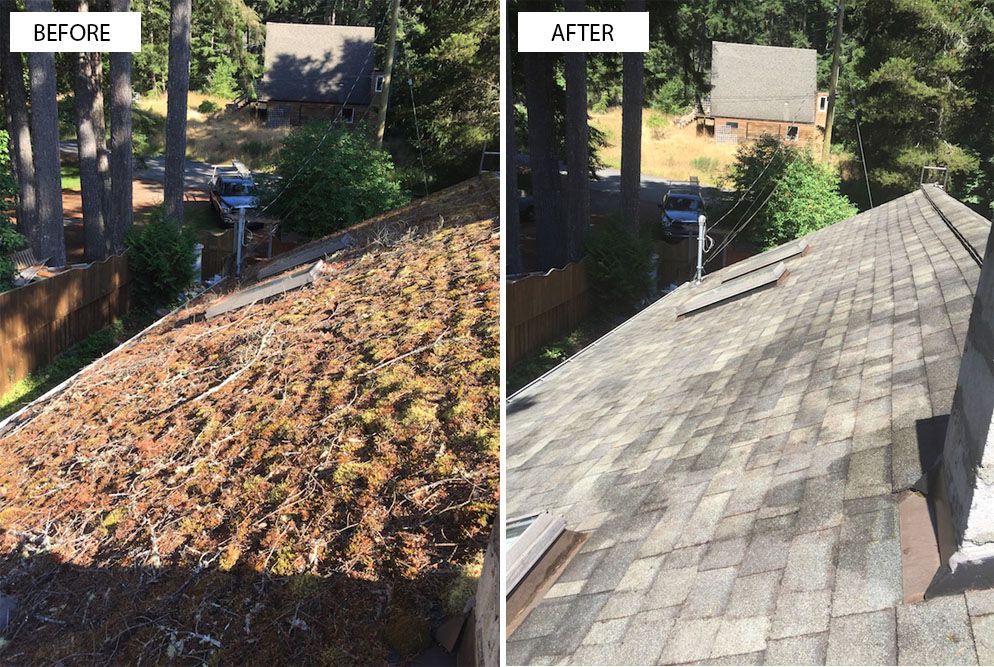
If you've lived in Victoria long enough, you've seen it: that creeping green-grey blanket spreading across a neighbour's roof. Roof moss isn't just unsightly — left unchecked, it can silently destroy the shingles protecting your home and cost thousands in repairs. The good news? With the right knowledge and a consistent maintenance routine, it's entirely preventable.
Why Victoria, BC Is a Moss Magnet
Victoria sits in the rain shadow of the Olympic Mountains, which gives it relatively mild, dry summers — but the fall and winter months are a different story. From October through April, the city experiences persistent moisture, fog, and overcast skies that keep rooftops damp for days on end. These are exactly the conditions that moss, algae, and lichen thrive in.
Unlike many colder Canadian cities where winter freeze-thaw cycles naturally prevent prolonged moss growth, Victoria’s temperate marine climate means moss can grow almost year-round. Combine this with the region’s abundance of conifer trees — which drop debris and cast heavy shade — and you have a near-perfect environment for roof moss to colonize.
North-facing roof sections and areas beneath large Douglas firs or cedar trees dry out the slowest after rain — making them the highest-risk zones for moss growth. If your home has significant tree cover, expect to maintain these sections more aggressively.
What Exactly Is Roof Moss — And Why Is It Dangerous?
Roof moss (Bryophyta) is a non-vascular plant that attaches to roof surfaces using structures called rhizoids. Unlike true roots, rhizoids don’t penetrate deeply into a substrate for nutrition — but they grip tightly to the rough surface of asphalt shingles, cedar shakes, and concrete tiles. Over time, this grip and the constant moisture retention that moss causes leads to serious structural damage.
The Three Stages of Moss Damage
Stage 1 — Surface Colonization (Year 1–2): Tiny moss spores land on your roof and begin germinating. At this stage, the moss is barely visible — a faint greenish tinge on the north slope. The shingles are not yet significantly damaged, and treatment is easy and inexpensive.
Stage 2 — Established Growth (Year 2–5): Moss forms visible cushions and mats across the roof. It begins to lift the edges of shingles as it expands and contracts with moisture cycles. Water can now penetrate beneath shingles more easily, increasing the risk of leaks, rot, and ice dams in freezing conditions.
Stage 3 — Deep Infestation (Year 5+): The moss mat is thick, heavy, and moisture-laden. The weight alone can stress the roof structure. Shingles are cracking, curling, and losing their granule coating. Lichen (which is even harder to remove than moss) may have joined the colony. At this stage, professional removal is required and partial or full roof replacement may be necessary.
A single mature moss mat can hold up to 3× its weight in water. On a heavily infested 2,000 sq ft roof, this can add hundreds of kilograms of moisture load — significantly stressing your roof deck and rafters over time.
Moss vs. Algae vs. Lichen: Know the Difference
| Organism | Appearance | Damage Level | Difficulty to Remove |
|---|---|---|---|
| Moss | Green, soft, cushion-like mats | High | Moderate |
| Algae | Black streaks, slimy surface film | Moderate | Low-Moderate |
| Lichen | Grey/orange crusty patches, flat | Very High | Very High |
Lichen deserves special mention: it’s a symbiotic organism composed of algae and fungi. Its root-like structures (called hyphae) actually penetrate the granule surface of asphalt shingles and embed into the shingle material itself. Removal requires professional treatment and can damage shingles in the process. Preventing lichen is far easier than removing it.
The Seven Best Roof Moss Prevention Strategies
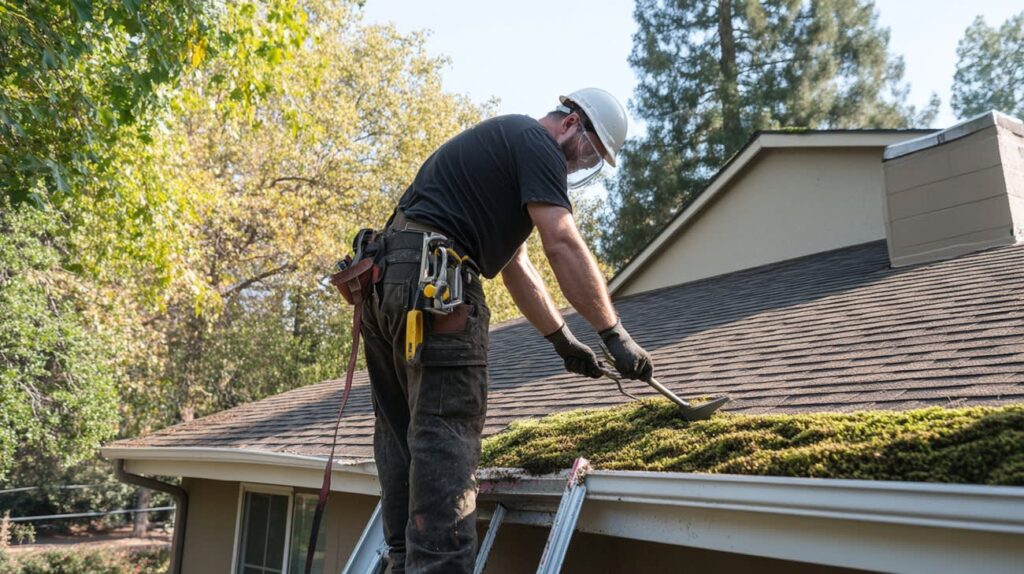
Prevention is always more effective and less costly than treatment. The following strategies, when used in combination, can dramatically reduce or eliminate moss growth on a Victoria home’s roof.
For large or steeply pitched roofs, we often recommend installing a second row of zinc strips at the mid-roof point, not just the ridge. This ensures the ions wash over the entire roof surface rather than only the upper half. Ask us about this during your next inspection.
Strategy 1: Zinc or Copper Strips
This is one of the most effective and long-lasting passive prevention methods available. Metal strips — typically made from zinc or copper — are installed along the ridge cap of your roof. Every time it rains, tiny amounts of metal ions are washed down the roof surface, creating an environment that is inhospitable to moss and algae growth.
Zinc strips are more commonly used because they’re less expensive, but copper is more effective and longer-lasting (copper can remain active for 20+ years). The strips are typically 6-inch-wide rolls installed under the first row of shingles at the ridge, with a 1–2 inch exposure. They require minimal maintenance and work passively every time it rains.
648mm
Annual average rainfall in Victoria, BC
6–7
Months of significant wet weather per year
40%
Potential lifespan reduction from untreated moss
Strategy 2: Regular Roof Cleaning & Debris Removal
Dead leaves, pine needles, and twigs that accumulate in valleys, gutters, and flat spots are the primary food and moisture sources for moss. Keeping your roof surface clear of organic debris is one of the simplest and most impactful things you can do. In Victoria’s tree-rich neighbourhoods, this typically means clearing your roof at minimum twice per year — once in late autumn after the main leaf fall, and once in early spring.
- Use a soft-bristle roof brush or a low-pressure leaf blower (never a pressure washer on shingles)
- Work from the ridge downward to avoid lifting shingles
- Clear all gutters and downspouts at the same time
- Check and clear roof valleys, which collect the most debris
Strategy 3: Tree Trimming and Canopy Management
In Victoria’s leafy neighbourhoods — particularly in Fairfield, Oak Bay, and Gordon Head — mature trees are part of the character of the landscape. But overhanging branches are a major contributor to roof moss problems. They shade the roof (preventing it from drying out), drop debris constantly, and can physically scrape against shingles in the wind, damaging the protective granule coating.
We recommend maintaining a minimum 3-foot clearance between any tree branch and your roofline. For large overhanging canopies, consider thinning the tree to allow more light and airflow to reach the roof surface. This is particularly impactful on north-facing slopes that receive little direct sunlight.
Strategy 4: Preventive Biocide Treatments
Zinc/copper strips work well for ongoing prevention, but for roofs that already have some moss history or are in high-risk locations, a preventive biocide application applied annually or biannually can provide excellent protection.
Products such as zinc sulfate granules, potassium soap-based roof treatments, or sodium hypochlorite solutions (applied by professionals) can kill existing spores and create a protective surface that inhibits new growth. The key distinction here is between preventive treatment (applied to a clean roof to prevent future growth) and remediation treatment (applied to an actively infested roof to kill existing moss).
Never use a high-pressure washer on asphalt shingles. The force strips away the protective granule coating, permanently reducing the lifespan of your shingles. Always use low pressure and appropriate cleaning solutions. This is a mistake we see frequently in Victoria, often done by well-meaning homeowners or unlicensed contractors.
Strategy 5: Improve Roof Drainage and Ventilation
Moisture that lingers on your roof surface is the root cause of moss growth. Anything you can do to help your roof dry faster after rain will reduce moss risk. This includes:
- Ensuring proper attic ventilation — a well-ventilated attic reduces the temperature differential between the roof deck and outside air, helping the surface dry faster and preventing ice dams
- Correcting any low-slope sections or flat spots where water pools
- Installing or clearing ridge vents and soffit vents to promote airflow
- Checking that gutters slope correctly — standing water in gutters wicks back onto the roofline and fascia
Strategy 6: Choose Moss-Resistant Roofing Materials at Replacement
If your roof is approaching end-of-life (typically 20–25 years for asphalt shingles in BC’s climate), the replacement is an excellent opportunity to choose materials with built-in moss resistance.
Many modern architectural shingles now come with algae-resistant granules embedded with copper or zinc compounds. Products like CertainTeed’s Landmark AR, GAF’s Timberline HDZ with StainGuard Plus, and IKO’s Cambridge AR are all available through suppliers in Victoria and offer enhanced protection compared to standard shingles in damp climates.
Strategy 7: Annual Professional Inspections
Even with the best preventive measures, a trained eye can spot early-stage moss growth, damaged flashing, or debris accumulation in areas that aren’t visible from the ground. We recommend Victoria homeowners schedule a professional roof inspection once per year — ideally in late spring after the rainy season — to assess the roof’s condition and catch any problems before they become expensive.
Victoria's Seasonal Roof Maintenance Calendar
Given Victoria’s distinct wet and dry seasons, a seasonal approach to roof maintenance is more effective than a once-a-year mindset. Here’s how to structure your efforts throughout the year.
Ideal Treatment Window
- Best time to apply moss killer and let it work in dry weather
- Trim overhanging tree branches
- Check metal strips for corrosion or lifting
- Inspect attic ventilation
- Clean any remaining algae streaks
Post-Rainy Season Assessment
- Schedule professional inspection
- Clear debris accumulated over winter
- Apply preventive biocide treatment
- Check and clean gutters
- Inspect flashing around chimneys and vents
Pre-Rain Season Prep
- Clear all leaf and needle accumulation
- Clean and flush gutters and downspouts
- Reapply preventive zinc sulfate if needed
- Check for any shingle damage or lifting
- Ensure valleys are clear for heavy rainfall
Monitor & Protect
- Monitor after major storms for debris accumulation
- Check gutters are draining freely
- Look for ice dam formation on north slopes
- Watch for dark streaking (algae) post-storm
- Note problem areas to address in spring
DIY vs. Professional Moss Treatment: What's Right for You?
Victoria homeowners are resourceful, and many ask whether they can handle roof moss treatment themselves. The honest answer is: it depends. For small, single-storey homes with low-slope roofs and early-stage moss growth, careful DIY treatment can be effective. For larger, steeper, or multi-storey roofs — or where growth is extensive — professional treatment is safer and more effective.
| Factor | DIY | Professional |
|---|---|---|
| Cost | Low ($50–200 in materials) | Higher ($400–1,500+) |
| Safety | Higher risk on steep/high roofs | Full safety equipment and training |
| Effectiveness | Good for early-stage, low-growth | Best for moderate to heavy growth |
| Risk to Roof | Higher if wrong products/methods used | Minimal with experienced contractor |
| Follow-up | Must monitor and re-treat yourself | Often includes warranty or follow-up |
Falls from roofs are one of the most common causes of serious home injury in Canada. In Victoria’s damp climate, moss-covered roofs are extremely slippery — even when they appear dry. If you have any doubt about safely accessing your roof, please hire a professional. No amount of money saved on DIY treatment is worth a serious injury.
For the majority of Victoria homeowners, we recommend a hybrid approach: DIY debris removal and gutter clearing twice per year (from a safe ladder at the eave level only), combined with a professional treatment and inspection every 1–2 years. This gives you the best results at a reasonable total cost.
Roof Moss Products: What Actually Works in BC's Climate
The home improvement market is flooded with moss and algae treatments, and not all of them perform equally in Victoria’s specific climate. Here’s a breakdown of the most commonly used product categories and our honest assessment of their effectiveness.
Zinc Sulfate Granules
Applied dry and left to wash into the roof surface with rain, zinc sulfate granules are one of the most cost-effective and widely used preventive treatments. They’re low-toxicity, easy to apply, and work well in Victoria’s rainy climate (the rain activates them). Best used as a preventive measure on a clean roof, or to slow active early-stage moss. Effectiveness window: 6–12 months per application.
Sodium Hypochlorite (Bleach-Based) Solutions
Diluted bleach solutions (typically 1–3% sodium hypochlorite) are highly effective at killing active moss, algae, and lichen quickly. They should be applied carefully to avoid runoff into garden beds and must be used responsibly near storm drains that lead to Victoria’s natural waterways. Never use at full concentration — always dilute appropriately. Professional application is recommended.
Potassium Soap / Fatty Acid Products
These are biodegradable, plant-derived treatments that are safer for surrounding vegetation and aquatic environments. Products like Wet & Forget and similar potassium soap formulas work more slowly than bleach-based products but are gentler on shingles and the environment. Ideal for preventive use and light-growth situations. They require several weeks or rainfall events to show full results.
Physical Removal + Treatment Combination
For moderate to heavy growth, the most effective approach combines careful physical removal of the moss mat (using a soft brush or specialized roof rake, working from ridge to eave) followed immediately by a biocide treatment to kill the remaining rhizoids. This is best done by professionals, as improper brushing can damage shingles or cause injury.
Understanding the Cost of Roof Moss in Victoria, BC
Many Victoria homeowners underestimate the financial impact of neglected roof moss. The costs fall into two categories: the cost of treatment (which is manageable) and the cost of the damage it causes (which can be significant).
Typical Treatment Costs in Victoria
- Professional moss inspection: $150–$300
- Professional cleaning and treatment (average home): $500–$1,200
- Zinc or copper strip installation (ridge only): $300–$600
- DIY zinc sulfate application (materials only): $50–$150
- Annual preventive treatment service contract: $300–$600/year
Typical Damage Costs If Moss Is Neglected
- Premature shingle replacement (partial re-roof): $5,000–$12,000
- Full roof replacement: $12,000–$25,000+ for a typical Victoria home
- Roof deck (plywood) replacement from rot: $2,000–$6,000 additional
- Interior water damage from leak: $3,000–$15,000+
- Mold remediation: $2,000–$10,000+
The math is clear: a consistent preventive maintenance budget of $300–$600 per year can protect you from repair costs that can easily exceed $20,000. This is one of the highest-return maintenance investments available to Victoria homeowners.
Frequently Asked Questions
Shoreline Roofing has been protecting Victoria homes from the elements for over two decades. Our team of licensed, insured roofers specializes in the unique challenges of BC’s damp coastal climate — including moss prevention, cedar shake maintenance, and storm-damage repair. We’ve inspected thousands of roofs across Greater Victoria and are committed to helping homeowners understand and protect their most valuable asset.
Ready to Protect Your Roof?
Shoreline Roofing offers free moss assessments for Victoria homeowners. Our team will inspect your roof, identify risk zones, and recommend a tailored prevention plan — with no obligation. Don’t wait until the damage is done. Call us at 250-413-7967 or visit shorelineroofing.ca to schedule your inspection today.