
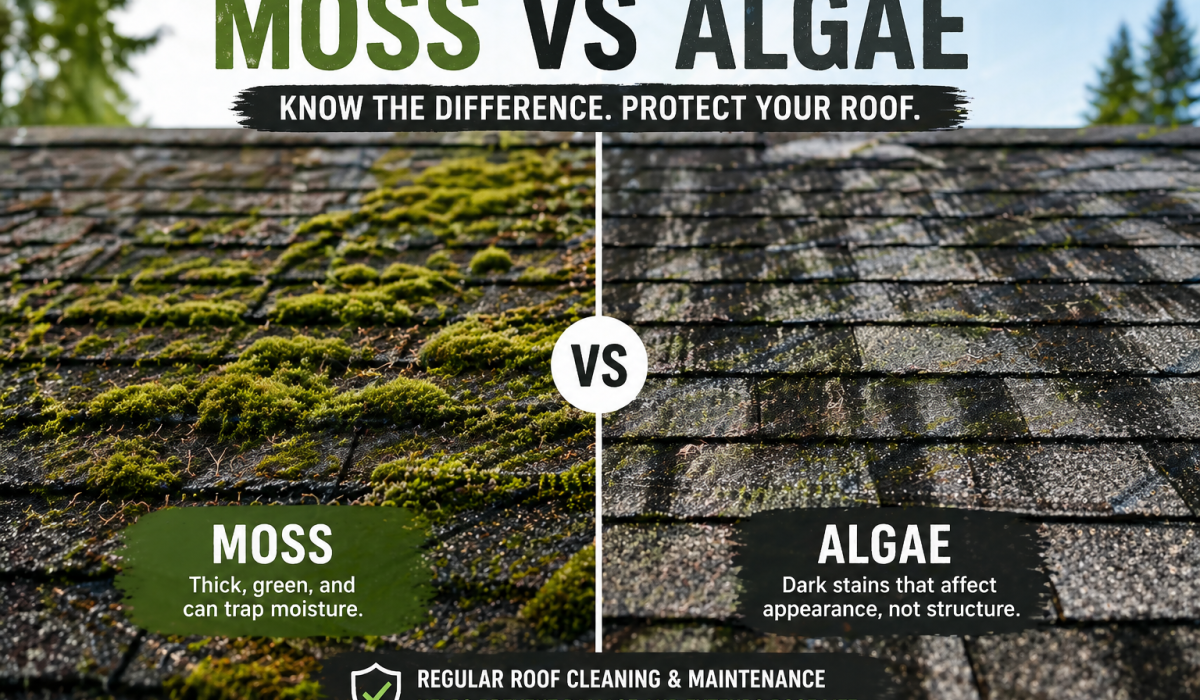
Moss vs. Algae: What’s Growing on Your Roof, and How to Fix It
Walk through almost any neighbourhood in Victoria — from Fairfield to Gordon Head, Oak Bay to Langford — and you’ll see the evidence everywhere: dark streaks running down shingles, patches of green cushioning on north-facing slopes, the occasional crusty grey growth that’s been there for years. Most homeowners lump all of it under “roof moss.” But moss, algae, and lichen are three fundamentally different organisms requiring different identification, different treatments, and different levels of urgency. Getting this wrong costs money. Getting it right protects your roof for years.
Meet the Three Organisms Growing on Victoria Rooftops
Before you can treat what’s growing on your roof, you need to know what it actually is. In Victoria’s damp, Pacific Northwest climate, three distinct organisms colonize rooftops — often simultaneously. Understanding each one’s biology, appearance, and mechanism of damage is the foundation of effective treatment.
| Organism | Appearance | Location on Roof | Damage Level | Treatment Difficulty |
|---|---|---|---|---|
| Moss (Bryophyta spp.) | Bright to dark green; raised, cushioned mats | North slopes, ridge, debris zones | High | Moderate |
| Algae (Gloeocapsa magma) | Black or dark grey flat streaks; no visible thickness | Entire roof surface; follows rain runoff | Moderate | Low–Moderate |
| Lichen (Algae + Fungi) | Crusty, flat patches; grey, white, or orange | Shaded, older shingle sections | Very High | Very High |
What makes Victoria particularly challenging is that these three organisms frequently co-exist on the same roof. A north-facing slope might have moss cushions in the valley, black algae streaking across the upper field of shingles, and lichen patches on older, low-sunlight sections near the eave. Each requires a targeted response — applying a single product hoping it kills everything is a common and costly mistake.
How to Identify Each One from the Ground
The good news is that you don’t need to get on your roof to identify what’s growing on it. With good binoculars or even just a clear sightline, the three organisms are visually distinct enough to differentiate from the ground — and that identification should happen before any contractor quotes your job.
Identifying Moss
Look for visible thickness and texture. Moss creates a fuzzy, three-dimensional appearance on the shingle surface. It’s most dense on north-facing slopes, in roof valleys, and anywhere debris accumulates. Fresh moss is bright green; older established moss may be darker or brown at the edges. You can often see it lifting the lower edge of shingles when viewed from the side. The raised, cushioned profile is the clearest distinguishing feature — moss has visible bulk that algae and lichen simply don’t.
Identifying Algae
Algae (Gloeocapsa magma) produces flat, dark streaks that run vertically down the roof surface, following the path of rain runoff. It is often mistaken for dirt, soot, or mildew — but the characteristic vertical streaking pattern and uniform dark colouration across an otherwise clean shingle is the giveaway. The dark colour comes from a UV-protective pigment the organism creates, not from surface contamination. The streaks have no visible thickness; the shingles look stained rather than colonized. In Victoria’s climate, algae can spread to cover entire roof faces within two to three seasons.
Identifying Lichen
Lichen appears as flat, irregular patches that look almost painted onto the shingle surface — grey, white, pale orange, or a mix of all three. Unlike moss, it has no visible cushioning or lift. Unlike algae, it appears in discrete patches rather than continuous streaks. The edges of lichen colonies often have a slightly raised, frilly or lobed appearance upon close inspection. Lichen grows extremely slowly — if you can see it clearly from the ground, it has likely been there for several years and has already begun penetrating the shingle material beneath the surface.
How Each Organism Damages Your Roof — and How Fast
The damage mechanisms are different for each organism, and understanding them helps you prioritize correctly — especially when working with a limited maintenance budget.
How Moss Damages Roofs
Moss is the most physically aggressive of the three. It attaches to shingles using hair-like structures called rhizoids, which grip the granule surface tightly. As moss grows and expands, it works its way under the overlapping shingle edges — physically lifting them away from the roof deck below. Once shingles are lifted, even slightly, they become vulnerable to wind damage, water infiltration, and freeze-thaw cracking in cooler months.
Equally damaging is moss’s extraordinary water retention capacity. A mature moss mat can hold up to three times its own dry weight in water — pressed against your shingles around the clock. This sustained moisture contact accelerates granule loss, softens the asphalt mat, and promotes rot in the underlying plywood decking. In Victoria’s months-long wet season, a moss-covered section of roof is essentially never dry, creating a continuous cycle of moisture damage that compounds season after season.
How Algae Damages Roofs
Gloeocapsa magma — the cyanobacteria responsible for almost all roof algae in the Pacific Northwest — causes damage through two mechanisms. First, it feeds on the limestone filler embedded in asphalt shingles. Manufacturers add limestone to add weight and thickness to shingles, but it also provides an ideal food source for this organism. As the algae digests the filler, shingles gradually thin and lose structural integrity over time.
Second, like moss, algae retains moisture on the shingle surface — slowing the natural drying cycle and keeping shingles wet longer after rain. The dark pigment the algae produces also absorbs more solar radiation than a clean shingle, increasing surface temperatures and accelerating thermal degradation of the asphalt material. Algae rarely causes obvious visible damage in the first year or two, but over five to ten years it meaningfully shortens shingle lifespan and can void manufacturer warranties if left untreated.
How Lichen Damages Roofs — The Most Serious Threat
Lichen is categorically different from moss and algae in how it damages roofing material. The fungal component of lichen produces root-like structures called hyphae that physically penetrate into the shingle surface — below the granule layer, into the asphalt mat itself. This is not surface colonization; it’s structural infiltration.
When lichen is physically removed without prior chemical treatment — scraped or brushed — it tears away the material it has penetrated, taking granules and surface asphalt with it and leaving exposed, pitted craters in the shingle surface. This is why lichen removal requires professional handling. Chemical treatment that kills the lichen must always precede any physical removal, and even then, the penetration damage to the shingle is often permanent. On older roofs, significant lichen colonization is frequently a sign that replacement is more economical than treatment.
Why Victoria, BC Is a High-Risk Environment for Roof Biology
You might wonder why this seems so much more prevalent here than in other Canadian cities. The answer is rooted in Victoria’s unique microclimate — a combination of factors that create near-ideal conditions for biological growth on rooftops year-round.
Persistent moisture without heavy frost. Unlike Edmonton or Winnipeg, Victoria rarely experiences prolonged hard freezes that naturally kill roof organisms. Moss, algae, and lichen can grow — or at minimum survive — through all twelve months of the year in Victoria’s mild marine climate. Organisms that would die back in a northern winter have no such check on the Island.
Year-round atmospheric humidity. Even in Victoria’s famously mild summers, proximity to the ocean keeps humidity levels elevated. Rooftops that might dry out completely in a drier inland climate stay marginally moist in Victoria — enough to sustain active growth during the “dry” season that algae and lichen in particular take full advantage of.
Abundant organic debris. Victoria’s urban forest is dominated by Douglas fir, western red cedar, garry oak, and ornamental species — all of which deposit acidic needles, leaves, and organic debris on rooftops throughout the year. This debris acts as both a food source and a moisture trap, creating micro-environments on the roof surface where organisms can establish themselves regardless of the shingle’s age or condition.
Shade-heavy residential streets. The tree canopy that defines Victoria’s neighbourhoods also shades rooftops — particularly north and west-facing slopes — for significant portions of the day even in midsummer. Direct UV light is the most effective natural inhibitor of roof organisms. Without it, there is little natural check on biological growth.
The Right Treatment for Each Organism
This is where most homeowners and even some contractors go wrong. Applying a single product in the same way to every organism will underperform at best and cause shingle damage at worst. Here is the correct approach for each.
Treating Moss: Kill First, Remove Second
The cardinal rule of moss treatment is never try to remove active, living moss before killing it. Live moss grips the shingle surface through its rhizoids — brushing or scraping live moss tears granules away with it. The correct sequence is always chemical treatment first, allowing the rhizoids to release their grip, then gentle physical removal or allowing natural weathering to clear the dead mat.
- Apply a biocide treatment. A zinc sulfate solution or diluted sodium hypochlorite is applied with a pump sprayer, working from ridge to eave. Dwell time varies by product — typically 15–30 minutes for bleach-based solutions, longer for zinc compounds.
- Allow the kill period. Wait one to four weeks. Dead moss will turn brown or orange. Do not attempt removal during this phase — the rhizoids are still releasing their grip on the shingle surface.
- Gentle physical removal if needed. Once fully dead, moss can be gently brushed away with a soft-bristle brush working downward, from ridge to eave only. Many homeowners opt to let rainfall clear it naturally over four to eight weeks — equally effective and safer for the shingles.
- Install a preventive measure. Zinc or copper strips at the ridge provide ongoing passive prevention. Every rain event washes metal ions down the surface, inhibiting future re-colonization.
Treating Algae: Effective but Often Misunderstood
Algae is the most straightforward of the three to treat, but it’s also the one most commonly treated incorrectly. Pressure washing removes the dark staining visually but does nothing to kill the organism, which rapidly regrows from surviving cells and airborne spores. The correct approach is chemical. A diluted sodium hypochlorite solution (1–3%) or a dedicated roof wash product applied as a low-pressure spray will kill the cyanobacteria on contact. The dark staining fades within several rain cycles as the dead cells wash away — typically four to eight weeks in Victoria’s climate.
For long-term prevention, algae-resistant shingles with copper-infused granules are now available from major manufacturers including GAF, CertainTeed, and IKO. These carry a 10–15 year algae-resistance warranty and are well worth the modest upgrade cost at next roof replacement given Victoria’s conditions.
Treating Lichen: A Long Game Requiring Professional Handling
Lichen treatment requires patience and specialist knowledge. Because the hyphae of lichen penetrate into the shingle material, there is no quick fix. The protocol involves applying a biocide — typically zinc sulfate or a specialized lichen-killing formulation — and then waiting three to six months for the lichen to fully die back and the hyphae to release from the shingle substrate. Attempts to remove lichen before this dwell period are completed will cause guaranteed shingle damage.
Even after successful treatment and natural weathering, the pitted areas where lichen penetrated may remain as permanent surface irregularities. On roofs where lichen coverage is extensive, an honest professional assessment should evaluate whether the cost of treatment justifies the remaining shingle lifespan, or whether planned replacement with moss and algae-resistant materials is the more economical path forward.
Treatment Method Comparison
| Method | Moss | Algae | Lichen | Safe for Shingles? |
|---|---|---|---|---|
| Zinc sulfate solution | High | Medium | Medium (slow) | Yes |
| Diluted sodium hypochlorite | High | High | Medium | Yes (when diluted) |
| Potassium soap / Wet & Forget | Medium | Medium | Low | Yes |
| Copper sulfate solution | High | High | High (slow) | Yes |
| Pressure washing | Cosmetic only | Cosmetic only | Cosmetic only | No — damages shingles |
| Zinc/copper ridge strips | Prevents regrowth | Prevents regrowth | Slows regrowth | Yes |
What Each Treatment Costs in Victoria, BC (2025)
Treatment costs vary depending on which organisms are present, the severity of growth, and the size and pitch of your roof. Here is a realistic range for professional treatment on an average Victoria home of 1,500 to 2,500 square feet:
- Moss treatment (inspection + chemical kill + debris removal + preventive treatment): $600–$1,100. Add $300–$600 for zinc strip installation. Most cost-effective when caught at early to mid-stage growth.
- Algae treatment (chemical wash + low-pressure application): $400–$750. The most affordable of the three. Results become visible within four to eight weeks as dead cells wash away with rainfall.
- Lichen treatment (professional-grade biocide, extended dwell period, specialist technique): $800–$1,500 or more. May require follow-up visits. A shingle replacement evaluation is often recommended alongside treatment for older roofs.
- Combined treatment (all three organisms, single visit): $800–$1,400 for most Victoria homes — significantly less than treating separately across multiple visits.
Long-Term Prevention: Keeping All Three at Bay
Once your roof has been treated, the goal is to maintain conditions that are hostile to all three organisms. The good news is that prevention strategies overlap significantly — a single consistent routine is effective against moss, algae, and lichen simultaneously.
- Install zinc or copper ridge strips. Metal ions washed down by rain inhibit all three organisms. Zinc is effective against moss and algae; copper offers broader-spectrum control that includes lichen. For high-risk roofs, combining zinc strips at the ridge with copper treatment at mid-slope problem areas provides the most complete passive coverage.
- Choose algae-resistant shingles at next replacement. Modern AR shingles from GAF, CertainTeed, and IKO include copper-granule technology that resists both algae and lichen colonization. In Victoria’s climate, this upgrade cost is well justified and typically covered by a 10–15 year manufacturer warranty.
- Manage debris and tree coverage aggressively. Clear leaves, needles, and organic debris at least twice yearly — once in late autumn, once in early spring. Trim branches to maintain a minimum three-foot clearance from the roof surface. This single step removes the primary food source and moisture trap that all three organisms depend on.
- Apply a preventive zinc sulfate wash annually. On high-risk roofs — those with heavy tree coverage, significant north-facing exposure, or a history of aggressive growth — an annual preventive application of zinc sulfate or a potassium soap product maintains a hostile surface environment before visible colonization begins.
- Schedule annual professional inspections. Early-stage moss, algae, and lichen are vastly cheaper to treat than established infestations. A trained professional will catch growth that’s invisible from the ground and identify high-risk zones before they become expensive problems.
Frequently Asked Questions
What are the black streaks on my roof in Victoria — is that moss or algae?
Almost certainly algae — specifically a cyanobacteria called Gloeocapsa magma. It produces a dark UV-protective pigment that creates the characteristic streaking pattern running vertically down the roof surface following rain flow. It is frequently mistaken for dirt or mildew, but it’s a living organism that feeds on the limestone filler in asphalt shingles. Pressure washing removes the visible staining temporarily but does not kill the organism, which quickly regrows. Chemical treatment is required for a lasting result.
Is moss or algae worse for my roof?
Both cause damage, but through different mechanisms and at different rates. Moss causes faster, more visible physical damage — lifting shingles, retaining large amounts of moisture, and creating conditions for rot in the roof decking. Algae causes slower, more gradual degradation by feeding on shingle materials and is generally easier and cheaper to treat. Lichen is the most serious of the three and the hardest to remediate. If all three are present simultaneously — which is common in Victoria — the recommended treatment priority is lichen first, then moss, then algae, though a qualified professional will address all three in a single visit where possible.
Can I use bleach to kill roof algae and moss myself?
A diluted sodium hypochlorite (household bleach) solution — typically a 1–3% concentration — is an effective treatment for roof algae and a useful contributor to moss control. However, DIY application carries significant risks: working on a wet, potentially mossy roof is dangerous; undiluted or over-concentrated bleach can damage shingles and surrounding vegetation; and improper runoff management can run afoul of Victoria’s stormwater bylaws, which protect the region’s sensitive marine waterways. For small, single-storey homes with light algae growth, careful DIY treatment is workable. For moss, lichen, steep-pitch roofs, or any multi-storey application, professional treatment is strongly recommended.
How long does it take for moss and algae treatment to work?
Timeline varies by organism and product type. Bleach-based treatments kill algae within hours; the visible dark staining fades over four to eight rain cycles, typically four to eight weeks in Victoria’s climate. For moss, the kill occurs within days, but the dead mat takes four to eight weeks to naturally weather away. Lichen treatment is the slowest — a properly applied biocide may take three to six months for the lichen to fully die and begin detaching. Do not attempt to scrub or remove any of these organisms before the kill phase is complete, as doing so causes shingle damage and disrupts the treatment process.
My neighbour’s roof has algae streaks — will mine get it too?
Quite possibly. Gloeocapsa magma spores are airborne and spread easily on wind and in rain. Roofs in close proximity with similar conditions — shade, moisture, north-facing exposure — will often develop algae around the same time. This is a good reason to coordinate treatment with neighbours where practical, and to install zinc or copper strips immediately after treatment to prevent re-colonization from neighbouring airborne spores.
Does Shoreline Roofing treat all three organisms, or do I need different contractors?
Shoreline Roofing treats all three — moss, algae, and lichen — as part of a comprehensive roof biology assessment and treatment service. We identify all organisms present during our initial inspection, scope the treatment to address each appropriately, and provide a written report documenting what was found and treated. You should never need more than one contractor for roof biological treatment. If a contractor claims they only treat one organism or applies a single product to everything regardless of what’s present, both are significant red flags worth noting before you hire.
Not Sure What’s Growing on Your Roof?
Let Shoreline Roofing identify the organisms, assess the damage, and recommend the right treatment — at no obligation to Victoria homeowners.
📞 Call (250)-413-7967