
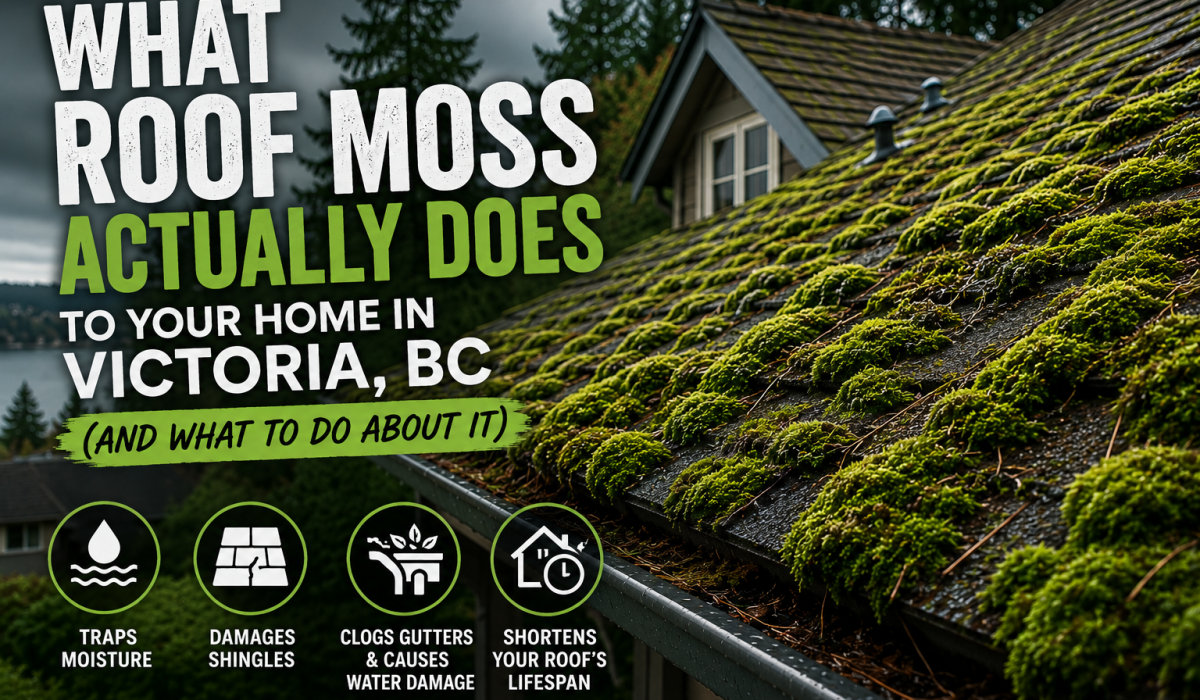
Most homeowners in Victoria notice the moss on their roof long before they do anything about it.
It starts as a faint green tint on the north-facing slope. Then a patch. Then a thick, spongy layer that covers a good portion of the shaded side of the roof. And most of the time, the thinking is the same:
It does not look great, but the roof is not leaking. It can wait.
That decision — understandable as it is — is where a lot of Victoria homeowners quietly start paying for a problem they did not have to pay for.
Moss on a roof in Victoria is not like moss on a garden wall. It is not decorative. It is not harmless. And in this climate, it is not slow.
This article breaks down exactly what roof moss does to your home, why it works faster here than in most other parts of Canada, and what the right response looks like depending on how far along the problem already is.
Why Moss Grows So Aggressively on Victoria Roofs
Victoria gives moss everything it needs to thrive: moisture, shade, cool temperatures, and surfaces that stay damp for long stretches.
The city sits in a temperate rainforest climate zone. Winters bring steady, prolonged rainfall rather than freeze-thaw cycles. Springs are cool and wet. Summers are relatively dry, but homes with significant tree coverage never fully lose the damp conditions that moss favors.
North-facing roof slopes are especially vulnerable. They receive less direct sun, dry out more slowly after rain, and tend to stay in the temperature range where moss grows fastest. Homes on wooded lots, or properties where mature trees shade the roof for most of the day, often develop visible moss growth within a few years of a new roof installation.
This is not a maintenance failure on the homeowner’s part. It is simply what happens in Victoria’s environment when nothing is done to interrupt the cycle.
The problem is what happens if that cycle is left to run.
Moss Is Not Sitting on Your Roof — It Is Working Against It
The most important thing to understand about roof moss is that it does not just rest on the surface. It anchors into it.
Moss grows by sending tiny root-like structures called rhizoids into the surface of roofing materials. On asphalt shingles, this means rhizoids are gradually working into the granule layer — the protective coating that gives shingles their weather resistance. Over time, that intrusion weakens the surface integrity of the shingle.
At the same time, the moss acts as a sponge. After every rainfall, it absorbs water and holds it directly against the roofing material for far longer than the surface would naturally stay wet on its own. Instead of shedding water and drying out, a moss-covered roof stays damp for hours or days longer than it should.
In a climate like Victoria’s — where rain arrives frequently and drying windows can be short — that extended moisture exposure adds up fast. The roof is simply wet more of the time than it was designed to be.
What Prolonged Moisture Does to Asphalt Shingles
Asphalt shingles are built to shed water, not hold it. When moss reverses that dynamic, the effects on the shingle itself are progressive and cumulative.
Granule loss accelerates. The protective granules on asphalt shingles resist UV damage and act as a barrier against moisture infiltration. Moss growth — and the moisture it traps — breaks down the bond between granules and the asphalt base faster than normal weathering alone. Granules begin washing off earlier than expected, showing up in gutters long before the roof reaches its projected lifespan.
Shingle edges begin to lift. As moss grows into and under shingle edges, it can cause edges to curl slightly upward. This creates small gaps where wind-driven rain can enter and where the shingle is no longer laying flat and shedding water cleanly.
The asphalt base dries out and cracks. Extended moisture retention followed by dry periods creates a repeated wet-dry cycle that stresses the asphalt base of the shingle. Over years, this accelerates brittleness and cracking in ways that normal aging alone would not produce at the same rate.
The underlayment comes under pressure sooner. Once the surface of the shingle is compromised, the underlayment — the secondary waterproof layer beneath the shingles — takes on more of the moisture load than it was designed to handle. When the underlayment also begins to fail, the roof is no longer providing reliable weather protection.
What this means practically is that a roof with persistent moss coverage in Victoria often does not reach its expected lifespan. A 25-year asphalt shingle may perform more like an 18-year shingle when moss-related moisture exposure is factored in over the life of the roof.
How Moss Disrupts Drainage and Creates New Problem Areas
A roof is a drainage system. Every slope, valley, and channel exists to move water off the surface as efficiently as possible.
Moss disrupts that system in several ways.
Thick moss growth slows water movement, particularly on lower-slope sections where water is already moving slowly. Instead of running cleanly off the roof, water lingers in moss-covered areas. Over time, debris — leaves, needles, organic matter — begins accumulating in the same spots where moss has slowed drainage. This creates buildup in roof valleys, around penetrations, and near gutters.
When gutters begin receiving this organic debris, they block more frequently. Blocked gutters cause water to back up along the roof edge, where prolonged moisture contact can damage fascia boards, soffits, and the sheathing immediately behind the gutter line.
In worse cases, backed-up water can work under shingles at the eave — particularly during sustained rainfall — and create interior moisture problems in the attic or along the top of exterior walls.
None of this is visible from the ground while it is happening. By the time a homeowner notices water staining on an interior ceiling or wall, the problem has already moved through multiple layers of the roof system.
The Hidden Cost of Ignoring Moss for Three or More Years
Short-term, moss on a roof in Victoria costs nothing obvious. There is no active leak. No emergency. No bill.
That is what makes it easy to defer.
But the cost accumulates in the background, and it surfaces in one of several ways:
Earlier-than-expected roof repairs. Sections of the roof showing the most moss coverage often need repair first — lifting shingles, failed seals, or localized damage to the underlayment. These repairs would not have been needed at the same point in the roof’s life without the accelerated moisture exposure.
Larger repair scopes. When moss is caught early, the damage is usually isolated and manageable. When it is left for years, the affected area tends to be wider, the shingle damage more extensive, and the repair cost proportionally higher.
Loss of warranty coverage. Many roofing material warranties include clauses around maintenance. If a manufacturer can demonstrate that neglected moss contributed to premature failure, warranty coverage may be reduced or voided.
Structural moisture damage. In cases where prolonged moss coverage has allowed sustained moisture intrusion, the damage can extend to roof decking, rafters, or insulation. At that point, the cost goes well beyond roofing materials.
Full roof replacement arriving sooner. This is the most significant financial outcome. A roof that should have lasted 22 to 25 years may need full replacement at 15 to 18 years when moss-related deterioration is factored in. That is a meaningful difference in the total cost of home ownership.
The math is consistent: early moss removal is far less expensive than the compounded cost of doing nothing.
When Moss Removal Is Enough — and When It Is Not
This is the question most Victoria homeowners eventually face, and the honest answer depends on the roof’s condition beneath the moss.
Moss removal is usually sufficient when:
- The roof is less than 15 years old and was in good condition before moss developed
- The shingles are intact with no widespread lifting, cracking, or granule loss
- There is no evidence of moisture intrusion in the attic or on interior ceilings
- The moss is caught at an early or moderate stage before it has become a thick, entrenched layer
- A professional inspection confirms the underlying roof system is still performing as intended
In these cases, proper moss removal followed by a preventative treatment can extend the roof’s remaining useful life significantly. This is the outcome homeowners want — affordable maintenance that avoids a much larger cost.
Moss removal alone is not enough when:
- The roof is already at or near the end of its expected lifespan
- Shingles show widespread granule loss, brittleness, or lifting across large sections
- Multiple repairs have already been made to the same areas
- Moisture has reached the underlayment, decking, or attic insulation
- A professional inspection finds that the structural integrity of the roof has been compromised
In these situations, cleaning a deteriorated roof only delays an inevitable replacement by a short time — and may cost money that would be better applied to the replacement itself. The right call is a proper assessment before spending anything on cleaning.
This is why a roof inspection before moss removal is worth doing. It separates the homeowners who need maintenance from the ones who need a replacement conversation.
How to Prevent Moss Growth on Victoria Homes
Prevention is not complicated, but it does require consistency.
Keep the roof surface clear of organic debris. Leaves, needles, and bark that accumulate on the roof retain moisture and give moss a starting point. Clearing this debris — particularly after fall — reduces the conditions that allow moss to establish.
Trim overhanging branches. Shade is the single biggest factor in moss growth. Trees that shade the roof for most of the day dramatically extend the time the roof stays wet after rain. Trimming back the canopy over key roof sections increases sun exposure and speeds drying.
Keep gutters clean and flowing freely. Blocked gutters cause moisture to back up along the roof edge. Clearing gutters each fall and monitoring them through winter is one of the simplest ways to protect the roof from unnecessary moisture exposure.
Monitor north-facing slopes closely. These sections are the first to develop moss and the last to dry after rain. They need more frequent attention than south-facing slopes.
Deal with early growth before it spreads. Small patches of moss are much easier and less expensive to treat than established coverage. A roof that gets checked annually is one where problems are caught at the stage where simple maintenance still works.
Consider zinc or copper treatments after professional removal. Certain metal-based treatments applied after moss removal can slow regrowth. These are not permanent solutions, but they extend the interval between removal services. Ask a qualified Victoria roofer which products and methods are appropriate for your specific roofing material.
When to Call a Professional: Signs That Need Expert Eyes
Some moss on a Victoria roof is a maintenance issue. Some of it is a warning sign of something more serious. Knowing which you are dealing with requires more than a look from the ground.
Call for a professional roof inspection if you notice:
- Thick, established moss covering a significant portion of the roof
- Dark, damp-looking sections that do not dry out in sunny weather
- Shingle edges that appear lifted or uneven from the ground
- Granules accumulating in the gutters in larger quantities than usual
- Water staining on interior ceilings or walls after heavy rain
- Soft spots or sagging visible in the roofline
- A roof that has not been inspected in three or more years
A trained eye can tell the difference between a roof that needs cleaning and one that has already begun to fail. That distinction determines what the right next step is — and spending money on the wrong one is a common and avoidable mistake.
Roof Moss Removal: What the Right Process Looks Like
DIY moss removal is tempting, but it carries real risks that homeowners often underestimate.
Pressure washing — the method most homeowners reach for first — can strip granules from asphalt shingles, force water under shingle edges, and cause more damage in an afternoon than moss would cause in a year. It is one of the fastest ways to void a roofing material warranty and shorten a roof’s remaining life.
Aggressive scrubbing has similar risks. Shingle surfaces are not designed to withstand physical abrasion. Removing moss by force without understanding the condition of the surface underneath can break shingles or expose the roof to damage it would not otherwise have suffered.
Professional moss removal uses methods and products appropriate to the specific roofing material, applies treatments designed to kill moss at the root rather than just scraping the surface growth, and includes an assessment of whether the roof shows any damage that needs to be addressed at the same time.
The goal is not a clean-looking roof.
The goal is a roof that is performing correctly — shedding water, maintaining its protective layers, and lasting as long as it was designed to last.
FAQ: Roof Moss in Victoria, BC
Is moss on a roof really a problem in Victoria, or is it mostly cosmetic? It is a real problem. Moss on roof Victoria homes traps moisture against roofing materials, interferes with drainage, and accelerates shingle deterioration in ways that eventually lead to earlier repairs or replacement. In Victoria’s wet climate, moss does more damage more quickly than in drier regions.
How quickly does moss damage a roof? It depends on coverage, roof age, and material. Light moss on a newer roof causes minimal damage over a few years. Thick, established moss on an older roof can cause meaningful deterioration in a shorter time — particularly if it is covering north-facing sections that already stay wet longest.
Is it safe to remove moss myself? For most homeowners, professional moss removal victoria bc is the safer choice. Improper cleaning methods — especially pressure washing or harsh scrubbing — can damage shingles and may void warranty coverage. A professional will use methods suited to your specific roofing material.
How often should I have moss removed from my roof in Victoria? That depends on tree coverage, shade, and how quickly moss reestablishes itself on your specific roof. Homes with heavy shade and significant tree coverage may need attention every two to three years. Annual inspections allow you to stay ahead of the problem before it becomes serious.
Can moss cause a roof leak? Moss itself does not create a hole in the roof, but it creates the conditions where leaks become more likely — weakened shingles, lifted edges, compromised drainage, and accelerated deterioration of the protective layers beneath the surface.
What is the best time of year for roof moss removal in Victoria? Late winter to early spring is generally well-timed. It follows the heaviest part of the wet season, catches moss before it enters its most active growing phase in spring, and allows any preventative treatments to work through the drier summer months.
Does a mossy roof need to be replaced, or can cleaning extend its life? Both outcomes are possible, and the only way to know which applies to your roof is an inspection. Moss removal extends the life of a roof that still has good underlying condition. It does not reverse deterioration in a roof that has already been significantly damaged. The inspection tells you which situation you are in.
Ready to Deal With Moss on Your Victoria Roof?
If you are seeing moss on your roof — whether it is a small patch or years of buildup — the right first step is finding out what you are actually dealing with.
Shoreline Roofing has been serving homeowners across Victoria and Greater Victoria for over 30 years. We work across Victoria, Saanich, Langford, Colwood, View Royal, Sidney, North Saanich, and Sooke, and we understand how the local climate affects roofs in this region.
A free moss inspection gives you a clear picture of the current condition of your roof, whether removal is the right next step or whether there are other issues that need to be addressed first, and what a realistic maintenance plan looks like for your specific roof.
No guessing. No unexpected surprises down the road.
Contact Shoreline Roofing today to schedule your free moss inspection and removal quote.
Also read: Why Roof Moss Is a Bigger Problem in Victoria Than Most Homeowners Realize