
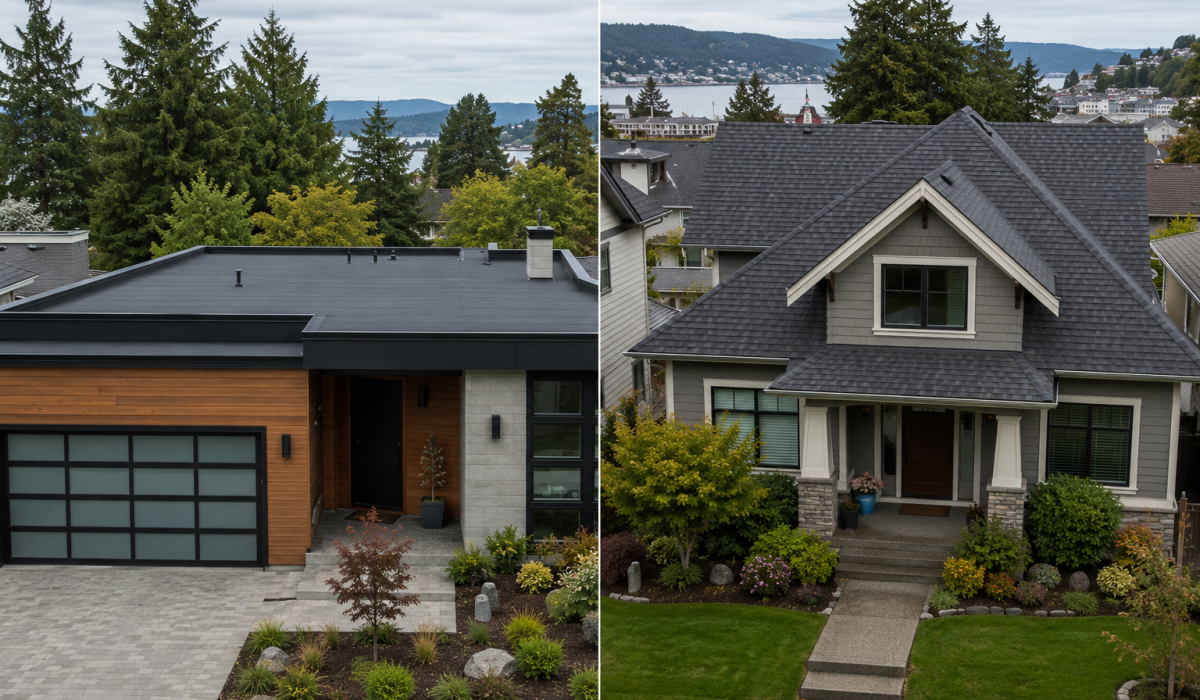
Whether you are building new, doing a major addition, or replacing an aging roof, the flat versus sloped question comes up more often than people expect in Victoria, where both styles show up across older heritage neighbourhoods and newer builds alike. Neither one is universally better. Each carries real tradeoffs in cost, maintenance, and how well it holds up against our specific rain patterns. Here is a straight comparison.
How each one actually sheds water
A sloped roof relies on gravity and pitch to move water off quickly, which is exactly why it has been the standard residential design for so long in wet climates. A flat roof, which is rarely perfectly flat but built with a slight low-pitch grade, relies on that gentle slope plus a membrane system and properly placed drains to move water off before it can pool. Both approaches work when installed and maintained correctly. Both fail in specific, predictable ways when they are not.
Flat roofs: the case for and against
- Where flat roofs make sense: Flat roofs are common on additions, modern architectural builds, and anywhere roof space doubles as a deck or green roof. They are generally less expensive to install for the same square footage than a comparable sloped roof, since there is less material and structural framing involved, and they allow for usable outdoor space that a sloped roof does not.
- The maintenance reality: Flat roofs need more regular attention than sloped roofs, full stop. Drains need to stay clear of debris, since a blocked drain on a flat roof means standing water rather than water simply running off. Membrane systems—whether torch-on, TPO (thermoplastic polyolefin), or EPDM (synthetic rubber)—have a shorter typical lifespan than a well-installed asphalt shingle sloped roof, often in the range of 15 to 25 years depending on the membrane type, versus 20 to 30-plus years for quality shingles. Ponding water, which happens when drainage is even slightly compromised, accelerates membrane wear significantly if left unaddressed.
In Victoria’s rain volume, a flat roof that is not inspected and maintained on a regular schedule is at real risk of slow leaks that can go unnoticed for a while, since water intrusion on a flat roof often shows up gradually rather than as an obvious drip.
Sloped roofs: the case for and against
- Where sloped roofs make sense: For most standard residential homes, a sloped roof remains the lower maintenance, longer lasting option. Water and debris naturally clear rather than requiring active drainage management, and asphalt shingle systems in particular are widely available, well understood by contractors, and comparatively affordable to repair when something does go wrong, since damage is usually localized to a specific area rather than a full membrane issue.
- The tradeoffs: Sloped roofs cost more to install for the same footprint due to the additional structural framing and material involved, and they do not offer usable rooftop space. Moss growth on north-facing, shaded slopes is a near-constant issue in our climate and needs periodic attention, though this is a maintenance task rather than a structural risk if kept up with.
Cost comparison, realistically
For a straightforward comparison on the same square footage, a quality flat roof membrane installation is often somewhat less expensive upfront than a full sloped asphalt shingle system, largely due to reduced framing and material requirements. Over a 20 to 25 year horizon, though, the picture shifts, since flat roofs typically need membrane replacement sooner and carry higher ongoing maintenance costs, particularly around drainage upkeep, than a well-maintained sloped shingle roof. The right comparison depends heavily on the specific project—an addition where flat roofing solves an architectural or space problem is a different calculation than a full home reroof where either style is genuinely on the table.
Insurance and resale considerations
Roof type can factor into both home insurance and resale in ways homeowners do not always anticipate. Some insurers ask specifically about flat roof age and last inspection date, given the higher claim rate historically associated with flat roof water damage compared to sloped, and may adjust premiums or ask for documentation accordingly. On resale, a well-documented maintenance history matters more for a flat roof than a sloped one, since buyers and their inspectors are often more cautious about flat roofing given its reputation, deserved or not, for higher maintenance needs. Keeping records of inspections, drainage maintenance, and any repairs is worth doing for either roof type, but pays off more directly for flat roof owners at resale time.
Which one actually suits your home
- Building an addition or want usable rooftop space: Flat roofing is often the practical choice.
- Standard residential reroof with no specific architectural constraint: Sloped roofing generally offers lower long-term maintenance.
- Heritage or character home in an established Victoria neighbourhood: Existing roof style and any heritage guidelines usually dictate the choice.
- Budget-conscious upfront cost with willingness to maintain drainage diligently: Flat roofing can work well.
- Priority on lowest ongoing maintenance over the roof’s lifespan: Sloped roofing tends to win out.
Membrane options for flat roofs, briefly
If a flat roof is the right fit for your project, the specific membrane type matters for both cost and durability. Torch-on modified bitumen has long been a common choice in the region and performs well when properly installed, though the installation process involves an open flame, which some homeowners prefer to avoid. TPO offers good durability and reflects heat well, generally at a moderate price point. EPDM is durable and relatively straightforward to repair if damaged, though it can be less UV-reflective than TPO. Each has tradeoffs in cost, installation method, and expected lifespan, and the right choice depends on the specific project and budget.
How roof style interacts with Victoria’s specific weather patterns
Victoria’s rain tends to arrive as sustained volume over the wet season rather than the short, intense downpours seen in some other climates, which actually favours both roof types in different ways. Sloped roofs handle the sustained volume well simply through gravity, with moss management being the main recurring maintenance item, mostly on shaded north-facing slopes. Flat roofs handle sustained rain fine too, provided drainage stays clear, but are more exposed to the occasional wind-driven rain events that can push water in directions the drainage system was not primarily designed for, which is part of why regular flat roof inspection matters more here than in a drier, calmer climate.
Frequently asked questions
Do flat roofs leak more than sloped roofs? Not inherently, but they are less forgiving of deferred maintenance. A sloped roof with a minor issue often sheds enough water to delay damage, while a flat roof with blocked drainage or a small membrane flaw can pool water directly over the weak spot.
How often should a flat roof be inspected? At minimum once or twice a year, and always after major storms, given how much drainage upkeep affects flat roof performance in a wet climate like Victoria’s.
Can I convert a sloped roof section to flat, or vice versa? It is possible but involves structural changes, not just a surface reroof, so it is a significantly bigger project than a standard roof replacement and worth a proper assessment before committing.
Which lasts longer in Victoria’s climate? A well-installed and consistently maintained sloped asphalt shingle roof generally outlasts a flat membrane roof, though a high-quality membrane system with diligent drainage maintenance can perform well for a long stretch too.
Which membrane type is best for a flat roof in this climate? There is no single best answer; it depends on budget, the specific application, and installation preferences. TPO and EPDM are both solid modern options with good track records locally, and a roofing professional can recommend based on your specific roof shape and use.
Can heritage home guidelines restrict which roof style I can use? In some established Victoria neighbourhoods with heritage designations, yes. It is worth checking with the municipality before assuming either style is automatically approved for a visible reroof on a heritage-designated property.
If you are weighing flat versus sloped for a reroof or addition, Shoreline Roofing can walk your specific property and give you a straight recommendation based on what actually makes sense for your home.